
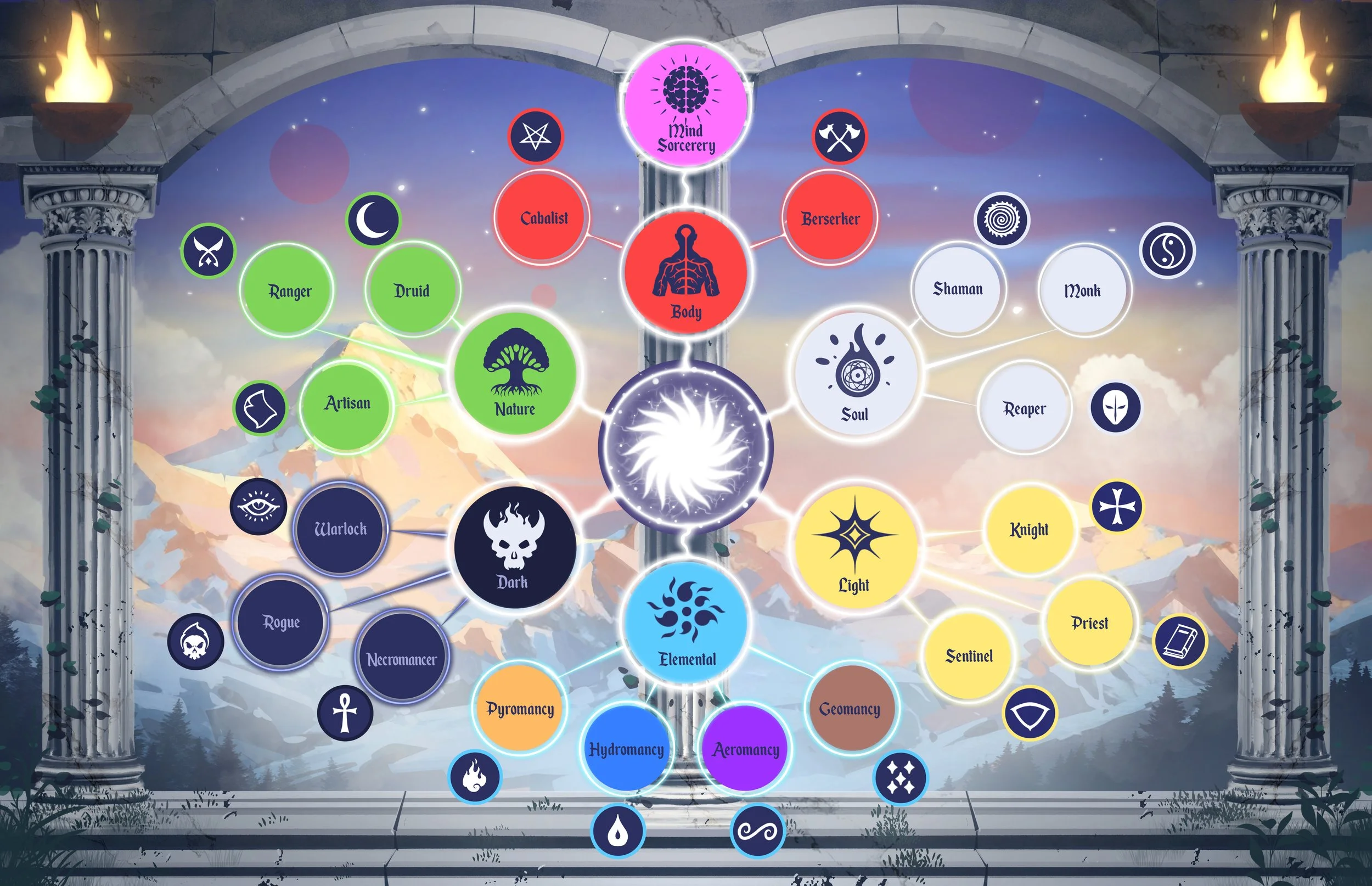
Diagram of Emanation Theory - modeled after the Tree of Life.
Alright, let’s get started on the basics of The Wandering Orders complex magic system. In order to understand Myth Tech, one must first understand where magic came from in the world of Kisharia. Although Kisharian scholars have debated for centuries on the ‘where’s, ‘how’s, and ‘why’s of magic, generally speaking, across many cultures and oral traditions, the story goes like this: 6,000 years ago, the world of Kisharia was inundated with a flood of magic that erupted from a singular source. Some call it ‘The First Source’, others call it the ‘Divine Spark’. My own preferred term is the former one. The Divine Spark essentially represents the oneness of all creation, and when the Spark erupted, what were once perfectly unified divine concepts were now made into 7 different parts, which were then split into several parts themselves. There are in total Seven Emanations: Mind (the First Emanation), Body (Second), Soul (Third), Nature (Fourth), Light (Fifth), Dark (Sixth), and Elemental (Seventh). A Mage is, by definition, anyone who is capable of using magic from any of the Emanation trees - whether they be Rangers, Knights, Warlocks, or Shamans, each branch is classified as ‘Mage’. Each of these branches were also given names, and cultures that used and discovered the different aspects of these Emanations gave them very common, simplistic names. A Mage who wields Hard-Light, for example, like our titular protagonist, Elara, is commonly known as a “Knight”. The same would then go for those who use Holy-Light, which is the Priest, and so and so forth. Each of these Emanations will be further explored and fleshed out in detail as the series continues, with each new entry heavily featuring and explaining one or several new Emanations not seen previously before.
Now, how does one obtain these exotic powers, exactly? Surely with so many Emanations there would be many Mages running amok in Kisharia? Well, not exactly. Each Emanation has its own ‘Ritual of Initiation’ that produces an extremely low turnover rate for those who succeed at doing it, even for those within Royal Families or Lineages typically only produce one Mage per generation, sometimes two, and represent a great majority of the worlds magic-wielders (more on that in future books!). These Rituals will be seen, and experienced in most cases, as the books explore each branch of magic. Without giving to much away, some of these rituals are brutal and intensive, and sometimes result in permanent harm to those who attempt to access it. Others simply fail it, and never gain access to their desired magic.
All living beings in Kisharia have what is called a ‘Source’. This Source was granted to them when the Spark first erupted. The Source really just means ones ability to attune themselves to their chosen magic. Most people, animals, etc, have an empty or unused Source, but they do still possess one. Upon successful completion of an Initiation Ritual, magic typically floods into ones Source, and from there granted the ability to wield and use the exotic powers of their chosen Emanation. You can almost view it as gaining a new sensory organ. Once it’s unlocked you feel, and use magic, the same way you do breathing: there isn’t really a conscious mechanism, more of a natural intuition that you feel once your Source is attuned. Elara, for example, can only use Hard-Light magic. A Rogue, then, can only use Umbramancy - which is Shadow manipulation/Shadow Magic in general.
Now then - how does this tie into Myth Tech? Well, since the Spark erupted in Kisharia, there have been eras of both stagnation and ‘quickening’ when it came to advancements in magic. Generally speaking, magic either accelerates or stagnates in 500 year segments since the Great Enchantment. 500 years before the start of Book 1, there was one such quickening. A major historical event, which won’t be elaborated on here, necessitated the advancement of current magic. And thus was born the idea of ‘Myth Tech’ - otherwise known as ‘Technology through Mythology’. A collection of the strongest Mages in the world gathered together, and created the city of Castorhaven: the worlds central hub of magic-infused ‘technology’ in an effort to enrich the world from the strife this particularly event caused. The advancements made in this 500 year era have brought to the classically ‘medieval’ world of Kisharia conveniences that resemble our modern-day technology. There are equivalents to the cell phone, the car, and even refrigerators, all made and created by the worlds most talented Mages with the greatest understanding of their respective Emanations.
Most Myth Tech devices were created by the Mind and Elemental branches, as those branches provide the basic raw materials needed to create these analogue magic-tech devices. Other Emanations, like the Nature branch, have contributed to Myth Tech as well, though.
Each of the branches have symbols associated with them as well to help draw in their power. These symbols take the shape of common Runes and Sigils. These Runes are also typically used to help new initiates attune their Source, as each rune naturally draws in or ‘signals’ magic of that type. A Light Rune signals Light magic, a Dark Rune Dark magic, etc etc. Sigils also sometimes correspond with these Runes, and are often used in either advanced level spellcraft, or in the creation and maintenance of various Myth Tech devices. The first presentation on Myth Tech, after this blog, will explain further how those work, with diagrams acting as visual assistance.
Lastly, I should state that magic in this world has an emotional component to it as well. It wouldn’t be proper magic without the idea of intention and will going into ones abilities. The Source is sympathetic in a sense - it responds to a users will, commitment, soul and heart. Some say the Source is conscious, and chooses its users, regardless of faith, nationality, race or creed. Items, substances, and technologies created with magic oftentimes use symbolic ingredients or methods to make them. Druids, for example, use longbows to cast their magic through: but as part of their initiation journey, they have to make the bow themselves with specific ingredients that represent aspects of, well, what it means to be a Druid. Again, there will be more on this in the near future!
That concludes our first Introductory Lesson to the world of Kisharia. Hopefully with this background on Emanation Theory, the Myth Tech devices featured in my succeeding posts will make sense to any and all newcomers just joining the series.
